Pages

Friday, 23 June 2017

Brisbane


Prior to arriving in Brisbane we explored the fascinating city of Bundaberg, famous for a certain rum that bears the city’s name. We’ve always recognised the Bundy brand name, as it’s been one of Australia’s most iconic trademarks. The most fascinating part of the factory tour was entering the molasses store – a million litres of thick syrup left over from the sugar mill that is conveniently just nextdoor. The roof keeps in the warmth and the remarkable smell. Instantly reminding us of treacle, the sweet odour was reflected in its taste, as we were given a small sample on a stick to try. The tour culminated in a little tasting at the end, and it is a unique Australian product.


Our two week stay in and around the Brisbane area included some catching up with old friends and workmates. We parked the van in the driveway of Karen, a former work colleague of Anne’s, and husband Rob who live in the northern Brisbane suburb of Narangba. It was a handy location from which to explore not only Brisbane but also its northerly tourist destinations. Bribie Island could almost be a Brisbane suburb and had some very nice parks, marinas, resorts and seaside residences. Redcliff is a northern coastal city famous for being an important part in the early childhood of The Bee Gees, and we found a recently constructed mall dedicated to the Gibb brothers. It was a cleverly displayed story of the group and was opened in 2013 by Barry Gibb himself, sadly the only remaining Gibb brother left alive.
We also visited a couple of my old workmates, Phil and Mirek, who both left work many years ago and retired with their wives to the Queensland warmth. It was an awful coincidence that at the same time we were told of the untimely death of another old workmate, Adrian, who had been visiting his daughter in Ireland but fell down her stairs and hit his head. He lay in a coma for ten days before the family had to make that most awful decision to turn off life support. It was such a shock, but in a small way it was comforting to share the news with others who had also worked with Adrian.
We had left home a few months before with a plan, which was to meet up with yet another old workmate of mine, Graeme, and his wife Christine on the Sunshine Coast after our Brisbane stay. They came to Queensland to see their son, however that plan was thrown out the window when their son ended up in a Brisbane hospital following a serious motorbike accident. They parked their caravan at nearby Ipswich to enable easy visits to the hospital, so we parked ours next to theirs and still enjoyed their company for a few days. In the following week their son made a full recovery and we took the opportunity to explore Warwick, Toowoomba and the surrounding Lockyer valley.

Sunday, 11 June 2017

Hervey Bay


There seems to be so many destinations down the Queensland coast that are worth exploring. The next one for us was Hervey Bay, and its a long esplanade with the sea on one side and shops, accommodation, restaurants and bars on the other. Plenty of grassed parks and gardens make this city an enjoyable living space.
Looks like snow, but it's actually sand.
Just off the coast is the remarkable Fraser Island, and we purchased a day-long four-wheel-drive tour to see it. What makes this large island so remarkable is that it is made entirely of sand. In fact it’s the world’s largest sand island, and a 4WD vehicle is essential to traverse it. From the ferry we drove the 22 kilometres across the island along a bush track made of soft sand. All of the island’s trees grow in soft sand, spreading their roots out wide to ensure they do not topple over. Emerging from the forest on the seaward side of the island, we drove up the beach on wet sand. We soon came across a major Fraser Island landmark on the beach – the rusting shipwreck of “The Mahino”. Washed ashore by a cyclone in 1935, photos show that it was a very large ship, but three-quarters of it is now buried under sand. For a short time in its long life it was used as a hospital ship at Gallipoli in 1915, giving it a special place in Australia’s history.
The wreck of "The Maheno" on Fraser Island.
Many freshwater creeks start in the Frazer Island highlands and flow to the sea, and we waded down the length of one of them (Eli Creek). Of course we waded on a bed of ubiquitous white sand. We also drove to one of many lakes in the middle of the island, this one was Lake MacKenzie, and its water was crystal clear on top of white sand. The sand at Lake MacKenzie is reportedly 92% silica, one of the purest silica sands in the world (the purest is apparently Whitehaven Beach in the Whitsundays, at 99%). Sand was ever-present wherever we went on Fraser Island, and it was impossible not to bring some of it home with you.
The seaward side of Fraser Island.
I soon realised that it had been a wise decision not to take my car onto Fraser Island, as the Toyota Landcruiser that took us was riddled with rust from the salty sea air. Every exposed piece of metal on the car was dark brown, and it had several blisters growing from under the paintwork - sure signs of the dreaded metallic cancer. Our tour guide said that their cars only have a lifespan of three years, after which they’re scrapped and new ones are bought.
Beach driving.
Hervey Bay is famous for whale sightings, and we weren’t disappointed. Standing on the beach, we witnessed several humpbacks frolicking out to sea, even breaching the surface to come crashing down to create a splash so big that we could hear it. It was an incredible sight, and we were lucky as whales are not usually spotted until July/August. “The first whales for the year” said our tour guide. “The first whales in our lifetime” we said.
In the distance, a humpback whale says hello.

As well as our tour guide Chris, we had a local indigenous guy called Pete with us, and he was fascinating, explaining many of the traditional customs of the original islanders. That’s one thing that we’ve witnessed throughout our journey so far – so many places have included an aboriginal interpretation of what we were seeing or experiencing. We think that’s fantastic, especially with so much emphasis along the Queensland coast on Captain Cook’s voyage of discovery in 1770. It seems that the imbalance is being restored.  

Tuesday, 6 June 2017

1770, the township.


When Captain Cook sailed up the east coast of Australia in 1770, he landed first at Botany Bay and secondly at a lovely little harbour a thousand kilometres further north. That little harbour was later named “1770” to commemorate the year of this event, making it a rare town by having a number for a name. Despite being 60 kilometres off the Bruce Highway, we took the detour and stayed there for two nights. Most commerce sits five kilometres away in nearby Agnes Waters where you can buy any of your essential needs, leaving 1770 with only a marina, restaurant, several accommodation options, and a pub with an open-air bar providing a million-dollar view over the harbour and out to sea. The lack of trendy surf shops, cocktail bars and night clubs made 1770 a lovely, peaceful and relaxing little town.
The lovely outlook from the bar in 1770.

The bush setting of the 1770 caravan park.
From here we explored Gladstone for a few hours. It seemed that this allotted amount of time was all that the place deserved, despite its population of 43,000. It had a large port facility for all types of seaward transport, from coal to containers, which made the extensive shoreline an ugly part of the city. Maybe our impression of Gladstone had been tainted by Cairns, Townsville, Mackay and Rockhampton.
The port of Gladstone


Venturing further south, we make it to Bundaberg, passing still more cane fields. Sugar cane has become the staple view from the Pajero ever since Cooktown. For hundreds of kilometres, sugar cane grows beside the roads of Far-North Queensland. When you look out over the top of a cane field, it looks like a paddock of grass, until you realise that it’s over three metres high. These paddocks stretch to the horizon, and the landscape is occasionally interrupted by a sugar refinery mill. Of course Bundaberg has a use for one of the by-products of sugar manufacture, namely molasses, to make Australia’s most famous rum, named after the town where the distillery is situated. We did the tour of Bundaberg rum factory, which concluded with a tasting of a choice of their many products. It certainly is an iconic part of Australia’s culture.
Bundaberg's icon ...
Bundaberg reminded us of our hometown Launceston, and indeed they have similar populations. However the surrounding areas are more popular with tourists and holiday makers, and we chose the little locality called Elliott Heads. Right on the beach, the caravan park had grassed sites and a brand new toilet block, and of course was chock-full of grey nomads – retired couples wandering Australia in a caravan or motor home.

Friday, 2 June 2017

Rockhampton


Throughout this journey we have utilised the tool that is essential when travelling around Oz. It’s called “Wikicamps”, it’s installed on your mobile phone, and it’s worth many times the seven dollar investment. Essentially a GPS satellite navigator, it points out caravan parks, camping grounds and points of interest together with reviews, photos and prices. Before moving on to our next night’s location, we refer to Wikicamps to figure out routes, destinations, distances and travel times. There’s little wonder why it’s so popular amongst travellers, and by following the traditional “wiki” philosophy, the more people who use it and update it, the more accurate it is. In this instance, we were yearning for a quiet camp after the hustle and bustle of the popular tourist spots along the Queensland coast. Wikicamps recommended a bush camp to the north of Rockhampton called “Fardooleys”, so we phoned ahead to secure a spot and tried it out. It was a revelation – low key because it does not advertise, and delightful for its simplicity.
Fardooley's Bush Camp.
Sitting high on a hill with spectacular views to the south over Rockhampton and the surrounding hillside, a large flat area provided room for about a dozen caravans along with a rudimentary but clean toilet/shower block, powered by solar panels for lights and a wood fire for hot water. Caravans had to provide their own solar power but water was available to each site. The owners Peter and Robyn were long retired and used the $12 a night per caravan to help boost their income, but we sensed that they received a lot more from meeting guests than from any financial gain. We were literally parked in their backyard, and they hosted drinks every day at 5pm in their own private entertainment area, where Robyn would pass around plates of nibblies, the guitars and ukuleles would come out and people from all over the world would socialise and chat. We spent four days here amongst new-found friends, enjoying the view and the beautiful sounds of the bush provided by a chorus of birds in the surrounding trees.
Of course we also explored Rockhampton and nearby Yeppoon, Emu Bay, Byfield National Park and Capricornia Caves. Rocky is a charming city of lovely parks and streets lined with palm trees and heritage buildings, giving it a certain charm. In contrast, Yeppoon is a trendy resort town on the coast with restaurants, cafes, bars and shops, with Great Keppel Island just a few kilometres out the sea. I think we’ve grown familiar with such places - Port Douglas, Palm Cove, Mission Beach, Airlie Beach and Yeppoon all share a similar vibe. They are beautiful places that not surprisingly attract thousands of tourists and provide access to the Great Barrier Reef, but at the same time they also lack a certain allure. Peter and Robyn’s bush camp was a welcome relief.
Capricornia caves, near Rockhampton.
Our next stay was another Wikicamps recommendation, in the old historic mining town of Mt Morgan on the southern side of Rocky. We asked a lot of the Pajero to haul the caravan up the winding and steep mountainside road but it didn’t miss a beat. We drove through the quaint and fascinating little town to reach the Silver Wattle Caravan Park, to be greeted by owners Sarah and Mark and their two small children. They also provided nibblies in their camp kitchen for 4 o’clock drinkies where we got to know the family better and met other park guests. Sarah and Mark received our admiration after learning their story – selling their Melbourne business to find a caravan park to buy, finding the Silver Wattle in northern Queensland and converting it from a run-down dump into a beautifully landscaped park that is a pleasure to stay in. The kids attend the local primary school and the business has become an essential cog in the economy of the town. They were a delightful family, and we stayed for four nights, including the first Queensland V N.S.W. State of Origin rugby game. Well, when in Rome, do as the Romans do.
The charming village of Mt Morgan.

Monday, 22 May 2017

Cyclone Debbie

Over a few days in Airlie Beach, we’d come to know Debbie quite well, even though we missed her by six weeks or so. It seems she tried her best to create havoc and heartache for people living in her path, but we also saw them snub their noses at Debbie and get on with their lives. Business owners thanked us sincerely for simply coming to stay. We certainly didn’t feel that we’d missed out on anything – we had a great time despite some businesses still being closed. Our caravan park had done a remarkable job in clearing up tonnes of flood debris and fallen trees. The local tavern might have had its carpet ruined by the torrential rain leaking through its roof, but it was still open for business, and was well patronised.  


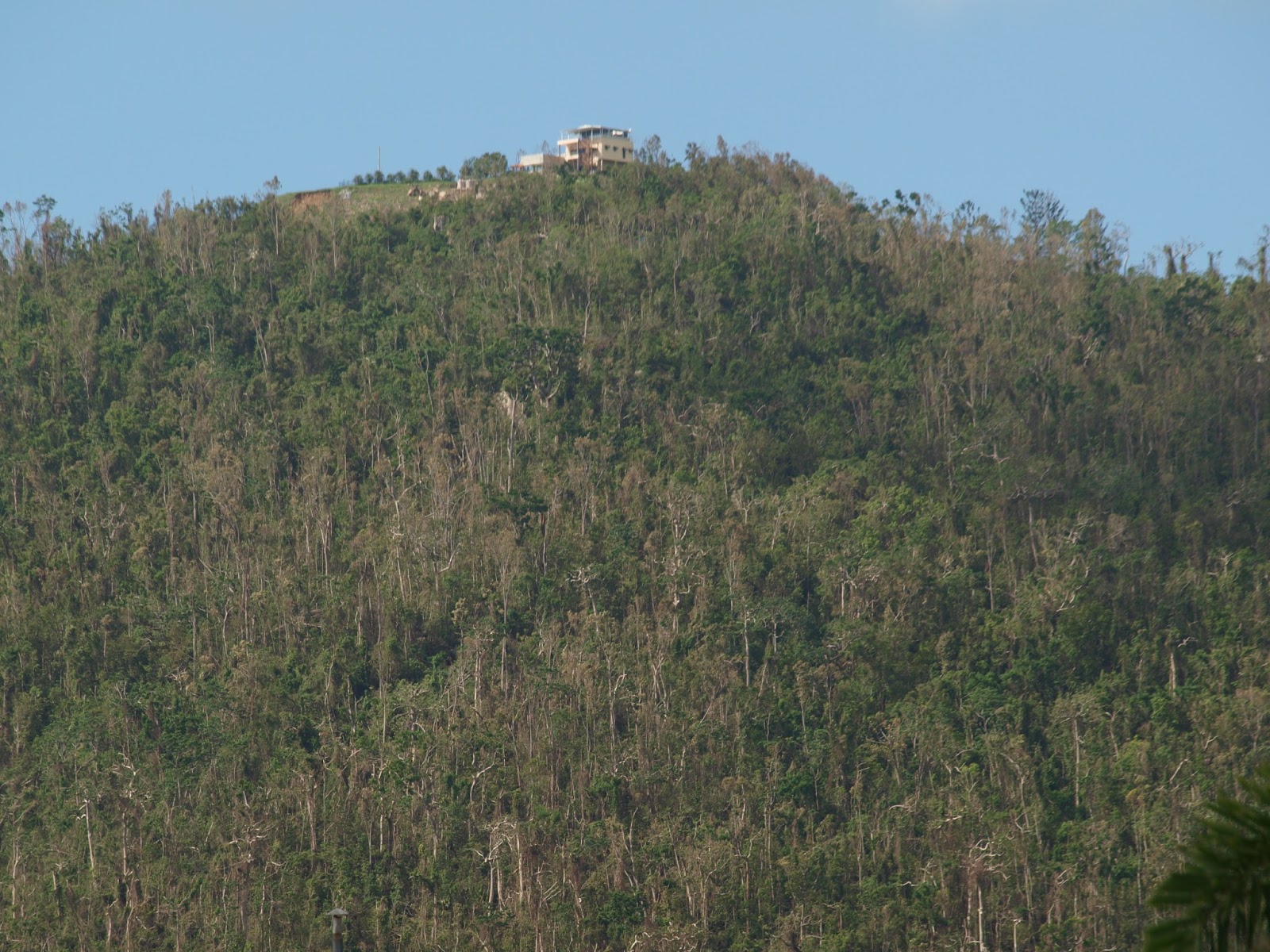
Airlie Beach is surrounded by hills, and on top of one hill sits a lone house, surrounded by forest and must have a commanding view of the town and the sea. We were told that this house was built by Don Algie, founder of the Hogs Breath chain of restaurants. He opened the very first Hogs Breath in Airlie in 1989. Who knows what the house cost to build, but we’re told that the 4 kilometre road that winds its way up the hill cost a cool $100,000 to construct on its own. There’s some serious money invested in Airlie Beach. The marinas are full of very large and very luxurious boats, and the hills are covered in equally large and luxurious hotels, resorts, apartments and homes. Clearly most of them had survived Debbie pretty well intact.
The mansion on the hill.
When I went snorkelling in the Whitsundays from our sailboat, I saw that the coral had been decimated by the storm, as if the underwater gardens had been destroyed by a ferocious wind. All the colours had gone, leaving fields of white debris crumbled on the sea floor. Large areas of what used to be coral had been covered in a slimy green carpet of algae, and I was told it was due to the abundance of fresh water from the mainland. However the abundant fish life ensured that there was some colour to provide a spectacle.
Dealing with the tonnes of fallen trees after Debbie.

On the outskirts of Airlie, Cannonvale and Proserpine were paddocks containing mountains of mulch. There must’ve been thousands of tonnes of green waste from the trees that had fallen and had to be cleared. On our journey further south to Mackay we saw countless broken and fallen trees. We stayed at Black’s Beach on the coast, just a few kilometres from the Mackay city centre, and this park, too, had to contend with Debbie and her aftermath. The resilience of these people is amazing, and we’re happy to do our little bit to aid in the recovery.
Debbie, showing her presence yet again.

Thursday, 18 May 2017

The Whitsundays


The road southbound from Port Douglas to Townsville was familiar for us, having travelled it just a few weeks before. This presented an opportunity to repeat our stay at Rollingstone caravan park, and it also happened to be a weekend, which meant that they’d have live music in the outdoor bar on the Saturday evening. Neal and Debbie followed us, and within a short time agreed with us that this was a splendid place to stay for a few days. And the bonus was that the live music was again supplied by Anu and Lawrie, who entertained us on ukuleles a few weeks before. They were happy to see us again, and even called in to see us the following morning before leaving for home back to Townsville.
Anu Grace and Lawrie Bycroft, wonderful musicians from Townsville.

Ever onwards to the south had us following the coast, while Deb and Neal turned right at Townsville for Charters Towers and their way home to Perth through central Australia. Our destination was Airlie Beach, which was a mission that we’d set ourselves six weeks before. On March 25th, the area around Bowen, Proserpine and Airlie Beach was pounded by Cyclone Debbie that left destruction and hardship in its wake. We thought that the least we could do would be to stay and inject a little business to help the recovery. Of course the gorgeous location of Airlie Beach being central to the Whitsunday Islands was an added bonus.
Airlie Beach is a large town that has some very trendy shops as well as the stock-standard range of commercial stores and fast-food outlets. However tourism as its main commercial focus. The forecast for later in the week was ominous with rain on the way, so we immediately did a trip out to the Whitsundays the following day. We sailed around many of the islands that make the Whitsundays so famous – Hayman, Hamilton, Daydream, and Molle Islands. The resorts on Hayman Island were still closed following the cyclone, and while the other islands were open for business, we could see many buildings surrounded by scaffolding while still under repair. We spent some time on spectacular Whitehaven Beach, seven kilometres of absolute white sand and crystal clear water on Whitsunday Island. It reminded us of Tassie’s own Bay of Fires north of St Helens, apart from the hundreds of tourists that, like us, had also been deposited on the beach.
Whitehaven Beach on Whitsunday Island, with evidence of Cyclone Debbie.


.
We learned about Cyclone Debbie after speaking to many locals. The winds began about 4pm on the Sunday and blew for the following 30 hours, and reached more than 250 kilometres an hour. I find it difficult to imagine the power of that ferocity. Then came the rain, as relentless as the wind but lasting for days longer. Six weeks later we can still see the aftermath, even with the massive clean-up and rebuilding. Most buildings have been restored  but we see many trees that have been broken off just a metre from the ground or stripped of all their leaves. The trees have unleashed new life by sprouting new offshoots, and the fresh green signifies survival.

A few kilometres beyond Airlie Beach is Shute Harbour, a tranquil bay that also accesses the Coral Sea and provides moorings for many leisure vessels. Debbie was not kind to Shute Harbour. We saw many buildings covered by tarpaulins, windows boarded up and surrounded by safety fencing, obviously unsuitable for habitation. Most remarkable where the large boats and yachts that were lying high and dry, many metres above water level. The tidal surge during Cyclone Debbie swept them into the mangroves on the shoreline and destroyed then in the process. Their fate now rests with what insurance the owners can get and whether they are salvageable. It was very sad to see.
Cyclone Debbie's destruction of Shute Harbour.

Thursday, 11 May 2017

Far North Queensland

So after 7,000 kilometres and seven weeks, we reached Cooktown and the most northerly point of our journey. We left the caravan in Port Douglas for a couple of nights and stayed in an on-site van in Cooktown after tackling the infamous Bloomfield coastal track through the Daintree rainforest. The alternative would’ve been a longer and much less interesting inland road that skirts around the Daintree.
The Bloomfield track was not as scary as the legend would have us believe. The several creek crossings were quite innocuous with so little rain of late, but the steep hill sections were quite extreme and tested the low range of the Pajero. Of course the coastal views were fantastic, and then the tropical rainforest would close in around us to block out the sun and create a dark, damp and mysterious environment.  
On the Bloomfield track between Cape Tribulation and Cooktown.

Cooktown was a delightful little place, quite the contrast to the commercial and touristy Port Douglas. Nearby is Grassy Hill, with a lighthouse and lookout at the top. It was from this very spot, in June 1770, that Captain Cook looked out over that section of the Great Barrier Reef and saw the several reefs just off the coast. He realised that he was in trouble and would have to be extremely careful to navigate his way back out to sea. His ship the “Endeavour” had been severely damaged by one such reef just south of here, and he had beached the ship just below Grassy Hill for seven weeks to repair it. It was on Grassy Hill that Europeans apparently saw a kangaroo for the first time.
You have to imagine it's June 1770 and Cook's "Endeavour" is right here on the beach.
Back in Port Douglas, we befriended a West Australian couple Neal and Debbie with whom we spent much of our time, and shared many meals and bottles of wine. We joined them for a day-long “Food and Wine” tour of the Atherton tablelands, and a fascinating day was had. Our tour guide, Brett, was passionate about Far-north Queensland and what it has to offer. We started at 9am with damper and bush tucker at an indigenous cultural centre (“Tjapukai”), and finished at 6pm with a wine watching for platypus beside a little creek in the middle of the bush. In between we sampled tropical fruit wines, drank locally grown coffee, tasted cheese and chocolate at a diary, and had lunch at a whiskey and gin distillery. We saw crops of cane sugar, bananas, peanuts, potatoes, maize, macadamias, avocadoes, blueberries, paw paw, mangoes, coconuts, tea and coffee.
One of many waterfalls in the Atherton tablelands.
When the time came to leave Port Douglas, we said our goodbyes to Neal and Debbie as they prepared to journey west to their home town of Perth and we headed south. We had an overnight stay at Paronella Park near Innisfail, an extraordinary park in a few hectares of beautiful rainforest. It built in the 1930s by Jose Paronella but destroyed many times over by floods, fire and cyclones. Although the buildings are in ruins, it was easy to appreciate Jose’s dream and be captivated by his vision from so long ago. He had emigrated from Catalonia in Spain and wanted to create his own little piece of Spain in Australia. We met the current owner Mark Evans, and his passion for restoring this remarkable place was inspiring.
Just of the charming buildings in Paronella Park.
Moving on the next day, we decided to pull into South Mission Beach for a few nights following a recommendation from a friendly local winery. Who should also be camped there, following a similar recommendation, but Neal and Debbie.  An amazing coincidence. The four of us did a day tour around nearby Dunk Island and some surrounding much smaller islands. Landing on one such small island for lunch, we were compelled to throw caution to the wind and take a swim in this idyllic location. We were assured that it was getting too cold for stingers now. As we sailed along the coast on the seaward side of the islands we could see several buildings, many being former resorts, that had been damaged by Cyclone Yasi in 2011. Instead of rebuilding, the owners simply collected the multi-million dollar insurance payouts and walked away, selling the properties for very little. It was quite strange to see so many unused and derelict beachfront buildings in a tropical paradise.
A swim and lunch on a remote beach.
Going cheap - one resort destroyed by cyclone.