Pages

Thursday, 21 June 2018

Indented Head and Gisborne, Victoria

Our caravan had sat patiently in the front yard for a few months while we enjoyed our beautiful granddaughter. Watching her grow and develop has been a heart-warming and joyous experience. Tearing ourselves away from little Lucy Kate wasn’t easy, but we hooked up the van to the Pajero and went back on the road for three months with the intention of reaching Mt Isa in Far North Central Queensland, promising to be back for Lucy’s first birthday in October. We still have a bad case of the Travel Bug, and there is an urgency to see more of Australia while we’re still fit and able to. The caravan hasn’t been used very much this year – a few weeks at the beach over Christmas/New Year and the occasional few days here and there. I’m sure the poor old girl was feeling neglected. It was time to get her wheels turning.

Bass Strait was not kind to us for the overnight sailing to the mainland. I suppose we were due for a rough crossing as it was our third trip in as many years and they’ve all been smooth and calm until this one. It was a case of hanging on for dear life while trying not to get tossed out of bed, and the mad dash to the bathroom was virtually impossible while the room was heaving from side to side. Thank goodness for the emergency sick bags being close by.

Anyway, things calmed down after 3am and some sleep was had before landfall arrived on schedule at 6am. First port of call was a few days at Indented Head near Geelong on the Bellarine Peninsula, and the home of friends Jenny and John. Having recently retired and moved from suburban Melbourne to this portside community, we could see why they’ve bought where they have. It’s a quiet and peaceful lifestyle combined with all the facilities of nearby Drysdale, Portarlington and Geelong. The foul weather that had upset our tummies on the voyage over continued for a few more days, but the sun eventually came out. We explored local wineries, cafes, beaches and scenic views. It certainly is a spectacular part of the country, and our hosts made us warmly welcome in their lovely new home.
The wreck of an old paddle steamer at Indented Head, Port Philip Bay.
When the time came to move on, the journey north began with a few days visiting Andrew and Pip in Gisborne, north-east of Melbourne. A year on from our last visit, it was like visiting old friends again, both the town and the family. It’s just another friendly, unique and intriguing part of the world.

A superb night at a little jazz club called “Wine O’Clock” in downtown Gisborne was a real treat. In such an intimate setting, it was as though they were playing just for us. And I must say it was delightful to take the dogs for a walk along the streets of Gisborne, particularly as they are flat. Just up the Calder Freeway is the delightful little town of Woodend, where the Holgate Hotel sits on the main street. After visiting there two years ago, it was very nice to re-sample some boutique beers from their on-site brewery.

We accompanied the family on a journey into Melbourne city by train to see an exhibition from New York’s Museum of Modern Art at the National Gallery of Victoria. It covered 130 years of artwork from artists such as Matisse, van Gogh, Gaugin, Toulouse-Lautrec, Picasso, Dali, Pollock and Whitely. Seeing original paintings by these masters was quite amazing. Certainly not something we do very often (actually, at all).
"Winter Wednesday" at Wine O'Clock, downtown Gisborne.


Taking the dogs for a walk with Pip and Andrew.

An original Brett Whitely.

Tuesday, 24 October 2017

Back home


I need to wrap up this latest adventure with an update of events since our return home from Europe. Our daughter met us at the airport, looking very pregnant but radiant, and it was so lovely to hold her in our arms. It was a Friday and her due date was the following Monday. Monday came and went without incident. The irony that we could’ve stayed those few extra days in Budapest crossed our minds for a nanosecond, but we’d been away for five weeks and were ready to come home. We desperately missed our daughter.

Little Lucy Kate arrived the following weekend, and announced her entry into the world with a healthy set of lungs, a pair of sparkling dark eyes and a beautiful crop of black hair. All fingers and toes were accounted for, and we welcomed this new human being into the world with adoration and wonderment. It was really just a continuation of the amazing journey that we’d set out on earlier in the year. We were still learning about the world around us and gaining unforgettable memories along the way.
 
Welcome to the world, Lucy Kate.
Since being home, we’ve seen some recent news items from places that we fondly remember. Angela Merkel won the German election that was raging when we were there, but she had to enter negotiations with minor parties to form a government. Many Germans I spoke to were not fans of Mrs Merkel. In Austria, we saw billboards and election placards everywhere, and the most striking ones pictured a handsome young guy called Sebastian Kurz, leader of the Austrian Peoples Party and only 31 years of age. He eventually won the election after again forming a coalition with other parties. There seems to be political upheaval all over the world.

We experienced seven European countries on this journey, each one had a cultural individuality. We only had pleasant exchanges with everyone we met while in these countries, and we never met anyone who was nasty or hostile. No matter what political unrest or religious trouble exists in the world, the vast majority of people just want to enjoy their life, look after their families and live their lives in peace.

Where to next? This is a big country, and it’s in a big world. There are no plans yet but there are still dreams. If Cruise Director Werney were here, he’d still be saying “It’s showtime”. 

Wednesday, 4 October 2017

Budapest, Hungary.


It’s strange where life leads you – we never thought we’d ever get back to Vienna after our first visit in 2009. Saying goodbye to this fabulous city for a 2nd time had us feeling quite sad. It’s such a friendly and liveable city, with wide open spaces of grass and trees, lakes and pathways, while also having tall buildings of glass contrasting with the old monuments and stone structures. The blue Danube stretches wide and long through the middle of the city. It’s just a superb place to be.

But our ship sailed on towards our journey’s completion. In the evening after departing Vienna we crossed into Slovakia as the Danube snaked its way towards the Black Sea. We very quickly came to the country’s capital, Bratislava, a city that I had toured briefly earlier in the day. Vienna and Bratislava are two of the closest capital cities in the world (the only closer capitals are Rome and the Vatican City). Both cities being so close to their country’s common border, it was less than an hour by road, and similar by river. And the two cities are certainly a contrast, as are the two countries.

Walking the streets of Bratislava made me think that I was in a previous communist country, and indeed Slovakia, when part of the former Czechoslovakia, was behind the Iron Curtain and was occupied by Warsaw Pact troops in the late 1960s. The country split with the Czech Republic in the early 1990s and Slovakia’s economy has been booming ever since. This strained recent history was quite evident in the buildings and monuments, and even the people were reserved and tentative while still being friendly and obliging. It was a fascinating few hours visiting such a different city to those of Germany and Austria.
Parliament building of Budapest. 
 We had our Farewell Dinner that night, with the usual fantastic food and wine in the plush restaurant. The entire crew came to bid us goodbye, and it was an emotional celebration. Much singing, dancing and partying was had late into the night. We went to bed in Slovakia and woke up in Hungary, and we made a spectacular mid-morning entry into the capital city, Budapest. It was so spectacular that the captain of our ship sailed up the Danube past the Parliament before doing a U-turn for another sail past. We docked directly opposite the Parliament, which meant that this incredible building dominated the view from our cabin window. Floodlit at night, that view was simply breathtaking.
Our home for two weeks, the Scenic Jade.
 Strangely, our final full day of the cruise was rainy, the first rain of the entire cruise. The crew were astounded that these past two weeks had been such good weather. The rain and poor visibility hampered our excursion, but we saw enough to know that Budapest is yet another beautiful European city. And again it has a chequered past in recent history, being the centre of the Hungarian Revolution of 1956. We heard stories of how life was so difficult when under the Nazi occupation of WW2, and then communist Socialist rule. Today it’s a vibrant and sparkling city, perfect for our tour to finish on a very high note.
The best waiter in Europe - Kristjan from Macedonia ...
... and the best Cruise Director, Werny from Rudesheim, Germany.
And so we are sitting in the lounge of the Scenic Jade waiting for our transport to the airport to begin our long journey home. Our friend Kristjan from Macedonia has just served us our final champagne, and we toasted a fond farewell to this ship that we’ve called home for 15 days. We’ve said goodbye to our new friends from the cruise – Derek and Sheelagh from Manchester, Dale and Rob from Saskatchewan, and Greg and Janelle from Brisbane. Then there was our room service lady Mina, butler Namanji, hotel manager Nemmin, barman Boris, receptionist Milli, waiters Paul and Almir, musician Marton (what a great pianist he is), from all different parts of the world. The crew have been so friendly, the ship so comfortable, the scenery so spectacular, the food and wines delicious, the service exemplary, the organisation like clockwork. We have nothing but praise for this tour, it’s been something we’ve never done before and difficult to imagine how we could ever better it again.

While we wait, clients for the next cruise are coming on board. There’s no rest for this crew, they will sail back to Amsterdam as the final cruise for the season. They’ll earn their holidays. We’re excited to be going home – we desperately miss our pregnant daughter. The latest is that she’s still in one piece. Just two more days and we’ll be together. But we’re also sad to be leaving our new friends on the Scenic Jade. As Cruise Director Werney would say prior to each day’s adventure – “Life is not a rehearsal. It’s showtime.”

Sunday, 1 October 2017

Vienna, Austria

Passau was the final German city to host our ship, but we all loaded on to buses to be driven across the German-Austrian border and into the Austrian Alps to the historic city of Salzburg. The guided tour of the old city was fascinating, and it was followed by a short drive into the hills to an authentic hillside restaurant to be wined and dined with delicious Austrian fare, including apple strudel. What followed would probably be expected for this region of Austria, as the hills came alive with the sound of music. A small orchestra of strings, brass and percussion provided backing to some exceptional singers performing songs from the 1965 film “The Sound of Music”, as well as some other traditional tunes. Earlier in the day we saw several locations from the famous Julie Andrews film. Afterwards the bus returned us to the ship that had by now moved further down the Danube to the Austrian city of Linz.
The staircase where Maria and the children sung "Do-Re-Me".

Part of the "Sound of Music" orchestra
The last Saturday in September for 2017 will always be a memorable day for us. Our incredibly resourceful Cruise Director, Werney, was able to locate and set up an internet connection and a large television screen to enable a bunch of Australians to watch the AFL Grand Final between Richmond and Adelaide.  The minor issue of it being screened live at 6:30 in the morning was not a problem – beers and German sausage were available and plentiful. We had a couple of Tigers supporters on the ship who took front row seats, and they were ecstatic by the end of the game. It was a momentous win by one of the original Melbourne football clubs, ending a 37 year drought.

The game finished just in time for a 9:30 departure to tour the massive Melk Abbey, a baroque Benedictine monastery in the quaint little medieval village of Melk. Founded in 1089, there were parts of this building that were a thousand years old. It was quite the spectacle, with statues, painted frescoes, and 800 year-old printed parchment, and an incredible library of antique books in a huge room with a balcony on the second level.  Leaving the abbey, the walk back to the ship took us through the old village of Melk with its narrow cobblestone streets and tiny one-room stores and cafes.
The birthplace of Wolfgang Amadeus Mozart, in Salzburg.
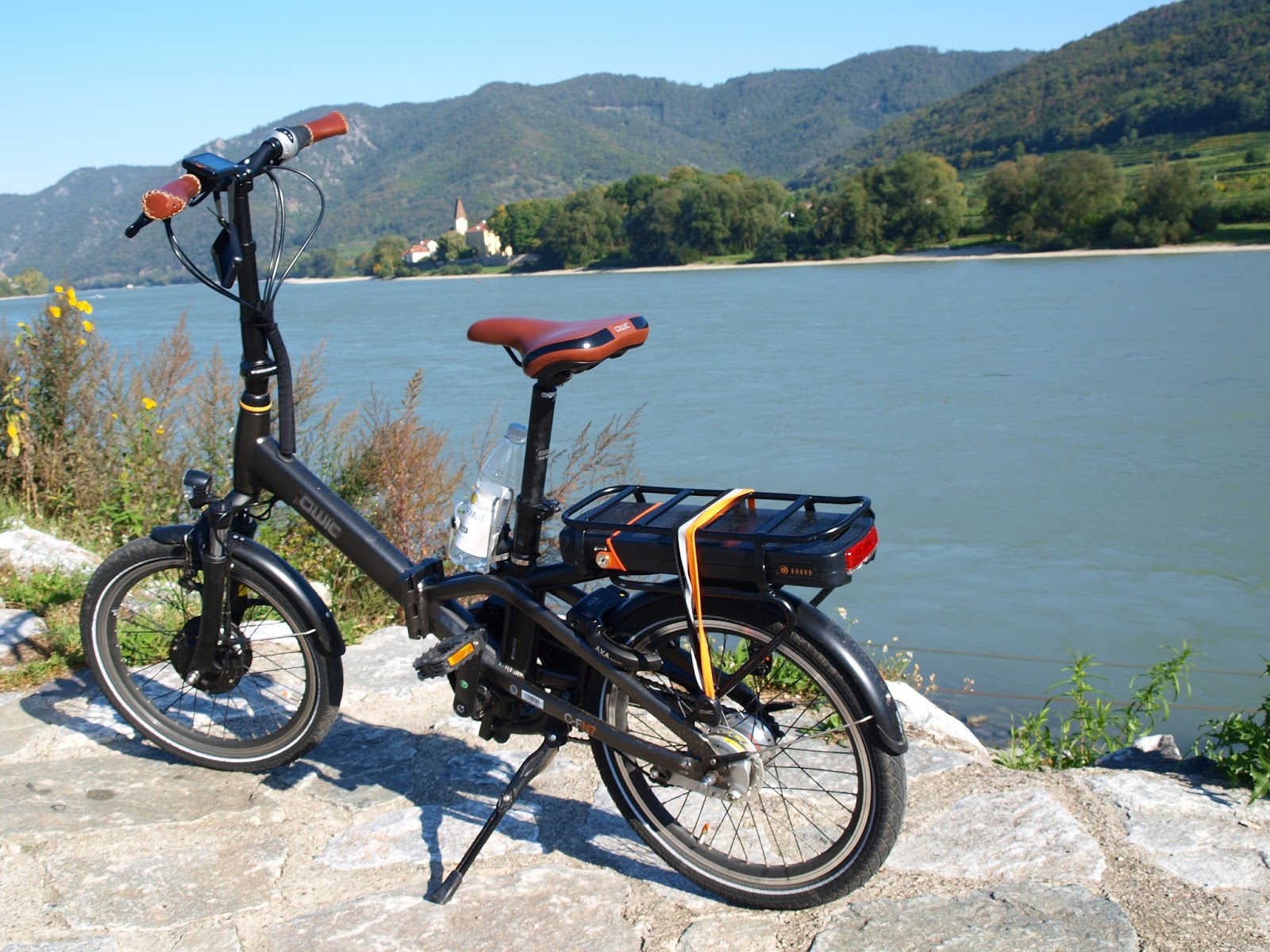
After lunch, a large group of us each took one of the ship’s bicycles for a guided tour of the Danube valley. It was a one-way trip, as the ship met us downstream in another quaint little medieval village called Durnstein. Things that made this ride very special – it was flat (which was simply heaven for a bike rider from Tasmania), the bikes had a little electric motor on the back wheel, and the scenery was varied and beautiful. Whenever you became tired of pedalling, you simply turned on the motor and enjoy being taken for a ride. We rode through several small villages, with the front doors of some homes opening directly onto the narrow cobblestone street. We rode through a large vineyard, with grapes dangling in all their fullness ready to be harvested. Indeed there were several workers in between rows with buckets of freshly picked bunches. The Danube River was always nearby, as if guiding us, and on the other side were rocky cliffs or steep vineyards or farm houses or a church spire. It was a quiet, peaceful, leisurely and scenic 32 kilometre ride.
Biking on the Danube.
We had an a two-day stay in Vienna, which was a bonus for us because it enabled us to spend a day with two special people, and locals as well. We met Alice when we first visited Vienna 8 years ago, and that chance meeting has grown into a wonderful long-distance friendship that has lasted. Alice and her partner Matt met us dockside in Vienna and the four of us spent a lovey day exploring Vienna, catching up and making the most of the nine hours we had together on this Sunday afternoon. It being Alice’s birthday was an added bonus

Thursday, 28 September 2017

The Danube River, Germany.


When we began this cruise a week ago in Amsterdam harbour, we were two metres below sea level. Our ship began ascending as we passed through the first lock, and a week and dozens of locks later, we reached the top of the European divide, over 400 metres above where we started. The Rhine and Main Rivers flow to the west, therefore we’ve been travelling against the current. We’re now on the Danube River and travelling with the current. The locks are now lowering us down instead of lifting us up. Last night’s lock was huge, lifting this large ship by an astonishing 20 metres. We entered its damp, dark corridor, and the door behind us slowly closed. Water was pumped into our dim enclosure and we gradually rose up out of the gloom and into the sun to be greeted by a panoramic view of pasture and forests. It was an engineering spectacle. The Rhine and Danube Rivers are connected by the Main-Danube Canal, completed in the 1990s, 170 kilometres long, and crosses over the top of the European divide, connecting west with east. It enables ships to sail from the Atlantic Ocean to the Black Sea.

Regensberg.

It’s virtually impossible to travel these parts and not be confronted by the Second World War. Most of the cities we’ve visited were 90% destroyed by Allied bombing. We did see some exceptions, such as the charming little cities of Bamberg and Regensberg. Their remarkable medieval town centres are still in their original state from 800 years ago. Perhaps the most confronting off-ship excursion was at Nuremberg. Our tour guide was a young German guy who had studied history and now philosophy, and the way he explained the events that led to the start of the war was a revelation for me. His explanation talked about propaganda, deception, ignorance – and then he compared Nazi Germany with ISIS in the Middle East and North Korea. You can see history repeating itself.
 
The Nazi Congress Hall, Nuremberg.
He showed us where the Nazi Party held their rallies each year from 1933 to 1938, attracting hundreds of thousands of young Germans. These Nuremberg rallies gained momentum for Hitler’s plans for German domination of Europe, and it was eerie to stand in the very spot where the Fuhrer actually addressed his fanatics. Just across the way was the Congress Hall, its red brick façade reflected in a thousand-year-old man-made lake. This building is one of the few remaining examples of Nazi architecture. Its design was based on the Colosseum in Rome but much larger and imposing. The war interrupted its construction and it was never completed. We saw the Grand Road, several kilometres long, where Hitler wanted to parade his troops. There were never any parades, and it’s now used as a pedestrian mall for markets and beer festivals.
The "Blue" Danube.
As we prepare to sail into Austria, Germany has been beautiful to us over the past week. Its people are beautiful, we have felt amongst friends. The history - ancient, medieval and recent - is astonishing. The countryside is green, the forests are a different shade of green, and everywhere you look there is something to see. This is a country that’s beckoning us back.

Sunday, 24 September 2017

The Main River, Germany


A few days into the 15-day cruise and we’re feeling a combination of contemplative relaxation and intense excitement. A daily routine has quickly developed – a comfortable sleep, a delicious breakfast, an intriguing excursion to a unique European city, an equally delicious evening meal with wine, and finish the day with a party and a nightcap. The very first thing to do in the morning is to open the curtains and lie in bed watching the ever-changing scenery. It’s like a huge movie screen showing a documentary on German river life, and a commentary is not required. The only sound to be heard is the gentle ripple of the water as the ship glides silently upstream. Some of the trees are beginning to change colour, like splashes of yellow, red and orange paint on a green canvas.
Our cabin window with an ever-changing view.
 People’s homes sit proudly on the river bank as their garden finishes at the water’s edge. The inhabitants go about their daily business commuting to work, walking their dogs (there are a lot of German Shepherds), wheeling a pram, dangling a fishing line, or camping in their caravan or motorhome (we’ve seen many riverside camping grounds, and they are all well attended). Ducks, geese and swans ignore us as we float by, too interested in finding their next meal. Sometimes the trees open out to reveal rolling hills of thick forests or fields of crops, grazing animals or grass pasture. Our progress eastwards is frequently slowed by passing through several locks each day as we gradually rise to the highest point in the European water drainage divide. Towns are marked by a church spire or steeple. A commuter train rushes by. We pass under bridges that vary from the very old, made of stone, to the ultra-modern made of concrete and steel. Some are so low that the sundeck is closed and the wheelhouse is actually lowered by hydraulics to enable the ship to pass.
Our cabin television shows a bow-cam, in High Definition.
 We’ve spent a day in Cologne with its gigantic cathedral, and then passed through the spectacular Rhine Gorge, 65 kilometres of geology, history and agriculture. On the northern side are hundreds of vineyards that’ve been planted on seemingly impossible slopes. By facing south the grapes make the most of the sunshine, but it’s hard to imagine a more difficult place to plant your vines. Most of these grapes are riesling, the origin of the famous Rhine Riesling. Several castles were perched high on the cliffs above us, some in ruins while others have been restored. Dating from several hundred to a couple of thousands years old, they look down us as if granting us permission to pass. Sometimes the grassy slopes give way to sheer rock faces several hundred metres high, but there’s always a little village or town located whenever the riverbank provides the opportunity, all with very German names like Oberwesel, Kaub, Urbar or Lykershausen.
One of many castles along the Rhine Gorge - part ruins, part restored.
 We stopped in the charming little town of Rudesheim, which happens to be the hometown of our Cruise Directory Werney, and he passionately commended its features. He was absolutely right, with little bars and cafes selling locally made wine and beer in narrow streets and laneways. A delight to get lost in. Further on upstream we stopped at Milternberg and Wertheim and Wurzburg. All of these cities were destroyed during the Second World War, and it’s remarkable how much work has gone into rebuilding them.

Thursday, 21 September 2017

The Amsterdam Rhine canal


I’m sitting in a plush, very well appointed hotel room. It has a comfortable bed, we’ve unpacked our cases into the generous wardrobes and drawers, and the bathroom is spacious with one of those multi-head showers that shoot water at you from all directions. An entire wall of our room is made of glass panels that open onto a balcony where we can sit and admire the view. This is where things become a little strange, for the view is changing from left to right at a constant 10 km/hr. Not more than 10 metres away is a grassy bank lined with trees beside a road with cars, trucks and bicycles, and beyond there are houses. Oops, spoke too soon – now it’s open agricultural land with cattle grazing. Now it’s changed again - there’s a factory with a tall chimney. Now there’s a ten storey office block dominating the view. More houses. The occasional fisherman has a line dangled in the canal while he sits on the grass enjoying a pleasant sunny Thursday afternoon. He gives a friendly wave. Here comes another bridge, we’ve probably passed under twenty in the last two hours.

We’ve left central Amsterdam on board the Scenic Jade, which is essentially a floating hotel at 135 metres long and 11 metres wide. We are two of 169 guests on board, and there are 43 hotel staff (that’s one for every four guests) and 7 nautical crew members. The experience began yesterday afternoon immediately after stepping out of the taxi, when a staff member met us and took our suitcases before leading us onto the ship. We didn’t see the luggage for the next hour as we were welcomed on board by several smiling, friendly people and a glass of champagne. Sitting in a palatial lounge with full floor-to-ceiling windows, we instantly began meeting fellow guests from Australia, Great Britain, Canada and the United States. We eventually checked in and were escorted to our room where we found our luggage. This must be the most salubrious hotel we’ve ever stayed in.

Sailing down the Rhine Canal heading south, we’ve said goodbye to Amsterdam, which has left an indelible mark on us. There are many construction sites around the city signalling a prosperous economy, and we have not seen any homeless or vagrant people that usually occur in big cities. There are more bikes than people in the Netherlands because commuters own at least two – one to ride to the nearest train or bus station, and another to ride to work after getting off. Consequently public transport stations always have hundreds of bikes waiting for their owners. The Dutch must be experts at water management, as 40% of the Netherlands is reclaimed land and much of it is below sea level. The clever use of dykes, canals, dams and ditches have transformed former lakes and sea frontage into viable agricultural, residential and commercial land. It’s an extraordinary country.

Only 1,820 kilometres to Budapest, but that’s still 14 days and four countries away.